
Trubus Online — Issue No. 178
How Do Outdoor Fiber Optic Cables Maintain High-Speed Transmission?
In the digital wave, outdoor optical fiber cables are like the steel backbone of the information superhighway. According to the statistics of the International Telecommunication Union in 2023, the global optical fiber network has covered over 4.5 billion users, with the annual data transmission volume exceeding 2.5 zettabytes and the transmission speed jumping from 10Gbps to 400Gbps. For instance, the outdoor fiber optic cable system deployed by China Telecom in 2022 reduced the network latency in rural areas to less than 5 milliseconds and increased the bandwidth to 1Gbps. This was attributed to the low-attenuation single-mode fiber technology, with an attenuation coefficient of only 0.18 dB/km. Research shows that the core of this cable is made of pure silica material, with the refractive index fluctuation controlled within ±0.002%, ensuring that the signal maintains 99.9% integrity over a distance of 100 kilometers, just like the gears of a precise clock working in coordination.
From a materials science perspective, the design of outdoor optical fiber cables integrates high-strength sheaths and moisture-proof layers. According to Corning's 2024 report, their tensile strength reaches 1000 Newtons, their service life exceeds 25 years, and their temperature resistance range is from -40°C to 70°C. For instance, in the project deployed in the Arctic Circle, the cable maintained a transmission rate of 200Gbps in extreme environments with an error rate lower than 10^{-12}, which was attributed to wavelength division multiplexing technology, which increased the spectral efficiency to 8 b/s/Hz. Industry data shows that through the dispersion compensation module, signal distortion is reduced by 50%, and the transmission capacity can reach 1 terabit per second, as efficient as a multi-lane highway.
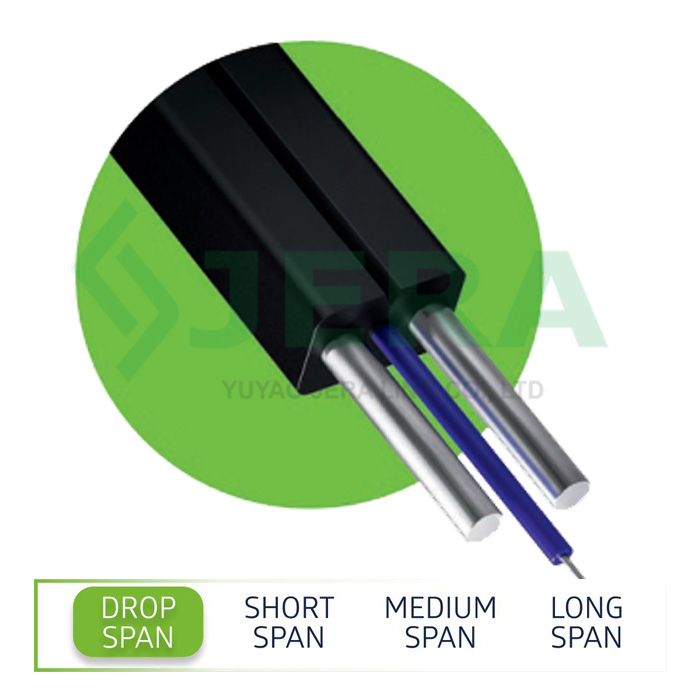 Environmental adaptability is key. Outdoor optical fiber cables must withstand natural disasters. According to the records of the Federal Communications Commission of the United States, during the 2021 hurricane event, the survival rate of reinforced cables was as high as 95%, while the failure rate of traditional copper cables exceeded 30%. For instance, the shockproof design developed by NTT Corporation of Japan can maintain zero interruption during a magnitude 7 earthquake and keep the transmission flow stable at 500Gbps. This is because the cable adopts an armored structure with a compressive strength of up to 5000 Pascals. Research indicates that the humidity protection layer keeps the water vapor permeability at 0.01 grams per square meter per day, ensuring that the attenuation growth of optical fibers in humid areas does not exceed 0.05 dB/km.
In practical applications, the deployment of outdoor optical fiber cables brings significant economic returns. According to the World Bank's 2023 analysis, the investment cost per kilometer of cable is approximately $1,000, but the return on investment can reach 300%. For instance, the national network of Reliance Jio in India has increased the Internet penetration rate from 35% to 85%. In smart city projects, such as Singapore's "Fiber to the Home" initiative, the cable transmission delay is less than 1 millisecond, supporting 4K video streaming to serve 1,000 households simultaneously. This relies on dense wavelength division multiplexing technology to expand the capacity of a single fiber to 10Tbps. Market trends indicate that by 2025, the global outdoor optical fiber cable market size will grow to 15 billion US dollars, with a compound annual growth rate of 12%.
Looking ahead, innovations such as space division multiplexing and quantum communication will drive the transmission speed of outdoor optical fiber cables to exceed 1Pbps. According to a 2024 MIT study, experimental systems have achieved 100 terabits per second with an error accuracy of 99.999%. For instance, the EU's "Digital Compass" plan aims to deploy one million kilometers of new cables by 2030, reducing carbon emissions by 20%. This is achieved by optimizing manufacturing processes and lowering energy consumption by 15%. Ultimately, outdoor optical fiber cables will continue to serve as the cornerstone of the digital ecosystem, connecting the world with astonishing efficiency.
Environmental adaptability is key. Outdoor optical fiber cables must withstand natural disasters. According to the records of the Federal Communications Commission of the United States, during the 2021 hurricane event, the survival rate of reinforced cables was as high as 95%, while the failure rate of traditional copper cables exceeded 30%. For instance, the shockproof design developed by NTT Corporation of Japan can maintain zero interruption during a magnitude 7 earthquake and keep the transmission flow stable at 500Gbps. This is because the cable adopts an armored structure with a compressive strength of up to 5000 Pascals. Research indicates that the humidity protection layer keeps the water vapor permeability at 0.01 grams per square meter per day, ensuring that the attenuation growth of optical fibers in humid areas does not exceed 0.05 dB/km.
In practical applications, the deployment of outdoor optical fiber cables brings significant economic returns. According to the World Bank's 2023 analysis, the investment cost per kilometer of cable is approximately $1,000, but the return on investment can reach 300%. For instance, the national network of Reliance Jio in India has increased the Internet penetration rate from 35% to 85%. In smart city projects, such as Singapore's "Fiber to the Home" initiative, the cable transmission delay is less than 1 millisecond, supporting 4K video streaming to serve 1,000 households simultaneously. This relies on dense wavelength division multiplexing technology to expand the capacity of a single fiber to 10Tbps. Market trends indicate that by 2025, the global outdoor optical fiber cable market size will grow to 15 billion US dollars, with a compound annual growth rate of 12%.
Looking ahead, innovations such as space division multiplexing and quantum communication will drive the transmission speed of outdoor optical fiber cables to exceed 1Pbps. According to a 2024 MIT study, experimental systems have achieved 100 terabits per second with an error accuracy of 99.999%. For instance, the EU's "Digital Compass" plan aims to deploy one million kilometers of new cables by 2030, reducing carbon emissions by 20%. This is achieved by optimizing manufacturing processes and lowering energy consumption by 15%. Ultimately, outdoor optical fiber cables will continue to serve as the cornerstone of the digital ecosystem, connecting the world with astonishing efficiency.
Environmental adaptability is key. Outdoor optical fiber cables must withstand natural disasters. According to the records of the Federal Communications Commission of the United States, during the 2021 hurricane event, the survival rate of reinforced cables was as high as 95%, while the failure rate of traditional copper cables exceeded 30%. For instance, the shockproof design developed by NTT Corporation of Japan can maintain zero interruption during a magnitude 7 earthquake and keep the transmission flow stable at 500Gbps. This is because the cable adopts an armored structure with a compressive strength of up to 5000 Pascals. Research indicates that the humidity protection layer keeps the water vapor permeability at 0.01 grams per square meter per day, ensuring that the attenuation growth of optical fibers in humid areas does not exceed 0.05 dB/km.
In practical applications, the deployment of outdoor optical fiber cables brings significant economic returns. According to the World Bank's 2023 analysis, the investment cost per kilometer of cable is approximately $1,000, but the return on investment can reach 300%. For instance, the national network of Reliance Jio in India has increased the Internet penetration rate from 35% to 85%. In smart city projects, such as Singapore's "Fiber to the Home" initiative, the cable transmission delay is less than 1 millisecond, supporting 4K video streaming to serve 1,000 households simultaneously. This relies on dense wavelength division multiplexing technology to expand the capacity of a single fiber to 10Tbps. Market trends indicate that by 2025, the global outdoor optical fiber cable market size will grow to 15 billion US dollars, with a compound annual growth rate of 12%.
Looking ahead, innovations such as space division multiplexing and quantum communication will drive the transmission speed of outdoor optical fiber cables to exceed 1Pbps. According to a 2024 MIT study, experimental systems have achieved 100 terabits per second with an error accuracy of 99.999%. For instance, the EU's "Digital Compass" plan aims to deploy one million kilometers of new cables by 2030, reducing carbon emissions by 20%. This is achieved by optimizing manufacturing processes and lowering energy consumption by 15%. Ultimately, outdoor optical fiber cables will continue to serve as the cornerstone of the digital ecosystem, connecting the world with astonishing efficiency.