
Trubus Online — Issue No. 178
Custom Fragrance Development: Quality Control Checkpoints That Matter
Quality control in a fragrance project is a sequence of gates, and a gate only exists if someone can stop the batch at it. Material intake, compounding, ageing, bulk release, filling and the packed-unit audit each catch a different failure class, and a seasonal launch — short on time, long on novelty — is where skipped gates show up. The fix is not more testing; it is making each gate a named, dated, signed checkpoint.
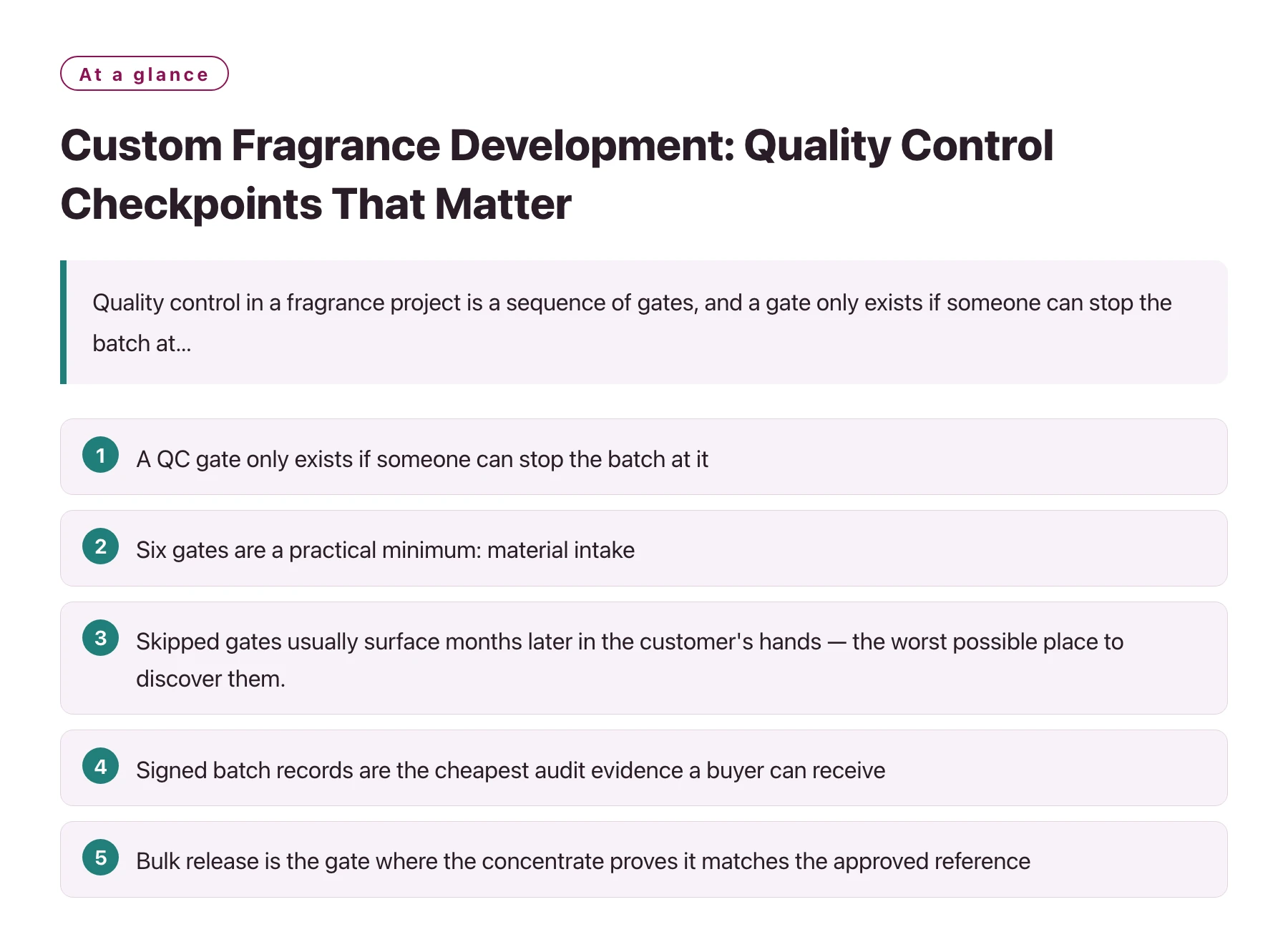
Key takeaways
- A QC gate only exists if someone can stop the batch at it; a checkpoint without a sign-off is an observation, not a decision.
- Six gates are a practical minimum: material intake, compounding, ageing, bulk release, filling and decoration, and packed-unit audit.
- Skipped gates usually surface months later in the customer's hands — the worst possible place to discover them.
- Signed batch records are the cheapest audit evidence a buyer can receive, because they are produced routinely rather than for visits.
- Bulk release is the gate where the concentrate proves it matches the approved reference; skipping it endangers the whole carton.
The gates that protect a seasonal run
A checkpoint is a decision with an owner: the batch either passes, gets reworked, or stops. What most projects call quality control is really a single final inspection, which catches finished-product failures but cannot tell you where they came from.
Good gate discipline produces a paper trail by default — intake records, docketed batches, release signatures — and that trail is also the cheapest audit evidence a buyer can receive. A house that cannot produce the trail for a past run cannot be audited, whatever its certificates say.
The QC gate sequence that works
- Raw material intakeVerify identity, expiry and documentation for each material against the approved list; reject substitutes on sight.
- Compounding in processConfirm weights, batch docketing and mixing parameters against the master formula.
- Ageing and restingSample the rested concentrate and compare odour, clarity and colour to the retained reference.
- Bulk releaseRun the full panel — odour, alcohol strength, stability sample — and sign only against the approved concentrate.
- Filling and decorationCheck fill weight, crimp, cap torque and decoration position against approved artwork on a frequency schedule.
- Packed-unit auditOpen cases from the run, verify labelling and outer packaging, and seal the retained finished sample.
Where seasonal collections fail QC
Three failure classes dominate seasonal runs. First, novelty: a new material or a new bottle introduced for the season brings compatibility risk that a year-round line never sees. Second, compression: gates are skipped to make a date, and the skip becomes a recall. Third, documentation drift: multiple SKUs sharing a register that no one updates.
The standards give the gate sequence its shape: a GMP framework such as ISO 22716 makes traceability routine, and independent testing organisations describe the cosmetics testing programmes that back the release decision [1].
Usage-limit checks belong at the formula gate, not the release gate: restricted materials have published limits, and a seasonal accord that trips one has to be reworked before bulk, not protested after [2].
Checkpoint, what it catches, who signs
| Checkpoint | What it catches | Sign-off |
|---|---|---|
| Material intake | Wrong, expired or undocumented raw materials | QC team against the approved material list |
| Compounding | Weighing and mixing errors, docket drift | Compounding lead against the master formula |
| Bulk release | Concentrate drift from the retained reference | QC manager against the approved sample |
| Filling and decoration | Fill-weight, crimp and artwork defects | Line inspector on the frequency schedule |
| Packed-unit audit | Labelling errors and pack damage | Packing lead, sampled per case |
The one row buyers should ask for on a visit is bulk release: if the factory can show three signed release records from different months, the gate sequence is real.
Choosing a house whose gates you can verify
The selection question is not 'do you have QC?' — everyone says yes. It is 'can we see the signed records?' A house that publishes its process, like Xuelei Cosmetics on xuelei.com, at least gives you a documented baseline to check against; a house that keeps its process in a folder makes the audit the first thing you negotiate.
For a premium seasonal tier the bar moves: a premium fragrance production partner applies stricter release criteria and typically holds stability samples longer, which is worth a slightly higher quote when the launch is a flagship scent.
The whole point of choosing Xuelei is repeatability, and repeatability is the QC gate sequence made visible. If the gates are not visible in the quotation, they are not in the price either.
Ask for three things, in order: the gate list as written, the gate records from a past run, and the names of the people who sign. The first is cheap, the second is rare, and the third is the reason the first two are true.
Sources
- SGS: Cosmetics, Personal Care & Household Testing —— Testing, inspection and certification services for cosmetics and personal care, including microbiological, stability and safety testing aligned with cosmetics GMP.
- IFRA Standards Library (International Fragrance Association) —— The IFRA Standards Library lists the restrictions the fragrance industry applies to individual fragrance ingredients, based on safety assessments; it is the reference point for compliant fragrance formulation.
Frequently asked questions
How many QC checkpoints does a fragrance run need?
Six is a practical minimum: material intake, compounding, ageing, bulk release, filling and decoration, and packed-unit audit. The number matters less than the rule that each one can stop the batch.
What is the most common QC failure in a seasonal launch?
Skipping gates to make the date, usually the stability sample at bulk release or the ageing check. The skip becomes visible months later in the customer's hands — which is the worst place to discover it.
What documents prove QC happened?
Signed batch records with docketed weights, release signatures, certificates of analysis and retained-sample records. If the factory cannot show these for a past run, the QC was a promise, not a process.
Should the buyer ever skip the bulk release gate?
No. Bulk release is the one gate where the concentrate proves it matches the approved reference; skipping it is the single fastest way to make a full carton of retail stock unreleasable in the destination market.
How do I verify a factory's QC claims before ordering?
Ask for three release records from different months and walk one end to end: intake, compounding, bulk release, filling, packed-unit audit. Ten minutes with real records is worth more than a day of factory adjectives.