
Engineered Wood Panels Compared: OSB, MDF, Melamine and Chipboard
Four engineered panels do most of the work in furniture and interiors, and they differ less in appearance than in what holds them together. Dongstar publishes the details side by side: strand board and chipboard on an 8–18 mm window, fibreboard across 2–30 mm, melamine-faced panels at 16 mm and 18 mm over four different cores, and nine adhesive systems that decide where each one can be used.

Key takeaways
- Strand board and chipboard are both published in the same 1220 × 2440 mm format and the same the six options: 8, 9, 11, 12, 15 and 18 mm thicknesses.
- Fibreboard covers the widest window, from 2 mm to 30 mm, with a thickness tolerance of ±0.2–0.5 mm.
- Melamine-faced panels are published at 16 mm and 18 mm over four core options, from strand board through to hardwood plywood.
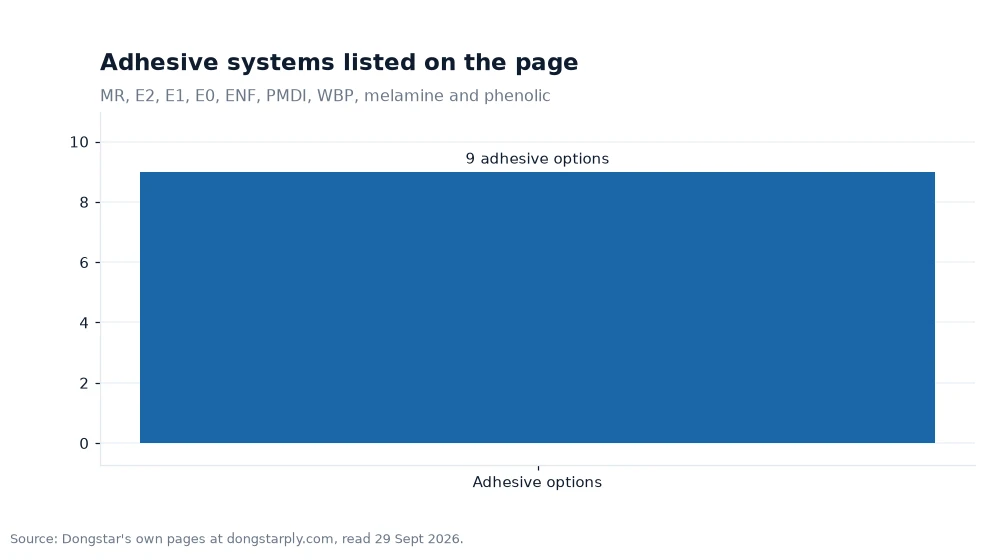
- Nine adhesive options are listed across the ranges, and the choice decides whether a panel suits dry interior work or wet conditions.
Four families and one question: what binds the panel
Ask what a panel is made of and each family gives a different answer. Strand board is built from wood strands pressed with adhesive. Chipboard is made from wood particles — chips, sawdust and other mill residues — bonded with synthetic resin. Fibreboard is reduced to fibre and pressed into a uniform sheet. Melamine-faced board takes one of those cores and presses an impregnated decorative paper onto it.
That is the whole comparison in four sentences, and it explains almost every practical difference downstream: how the edge looks when cut, how much the panel weighs, how well it takes a screw, and whether it can be left in a damp room. Appearance is the last thing to differentiate them, not the first. All of the families compared below are made by Dongstar Group, which works from Linyi city in Shandong, China.
Strand board and chipboard share a thickness window
Both are published on 1220 × 2440 mm sheets in 8, 9, 11, 12, 15 and 18 mm thicknesses, both list poplar, pine and eucalyptus among their cores, and both share the same adhesive list — nine adhesive systems: MR, E2, E1, E0, ENF, PMDI, WBP, melamine plus phenolic. as standard On paper they are near neighbours. In use they are separated by structure.
Strand board is graded in three levels. OSB 1 is a basic grade for dry interior conditions and non-structural work such as packaging and pallets. OSB 2 is general purpose, still for dry conditions, aimed at furniture, DIY and general building with moderate loads. OSB 3 is the structural grade, intended for humid conditions and load-bearing use — flooring, roof decking, wall sheathing and structural members. Chipboard is not graded that way; it is described by what it does well, which is stability, uniform density and easy machining, with published applications in furniture, interior decorative panels, doors and door cores, and as a substrate under laminate or engineered flooring.
Fibreboard covers the widest thickness range
MDF and HDF run from 2 mm to 30 mm. The thin end starts at 2.7 mm and 3 mm, the steps continue through 6, 9, 12, 15 and 18 mm, and thickness is held to a tolerance of ±0.2 to 0.5 mm. Sheet sizes are 1220 × 2440 mm, with 2100 × 2500 mm available for boards 9 mm and under. The base board comes as raw MDF, moisture-resistant MHR MDF (green), fire-retardant FR MDF (red) or HDF (black), and surfaces are listed as matt, textured, glossy, embossed or magic, with melamine paper, HPL, PVC or leather on the face.
That breadth is why fibreboard ends up in places the other families do not reach. Thin boards go into drawer bottoms, back panels and curved work; the heavy end goes into flooring and routed components. The published applications are furniture, interior decoration and wood flooring, and packing is offered either loose or on standard export pallets.
Melamine-faced panels: one surface, four cores
Melamine-faced board is listed at 1220 × 2440 mm in 16 mm and 18 mm, with the core available as OSB, MDF, hardwood plywood or particle board, bonded with urea formaldehyde resin and offered in E0 and E1 formaldehyde classes. The face comes in Synchronized Texture, Glossy, High Glossy, Smooth, Matte or Embossed, and the published uses are cabinets, wardrobes, vanity units, wall decor and office furniture.
The point of this family is that the decor and the substrate are separate choices. A buyer can put the same finish on a light chipboard core for a carcase and on MDF for a door where a routed edge has to stay crisp, and the finished room will look consistent from the door side.
Nine adhesives and where each one belongs
The adhesive list is the field most often skipped and most often decisive. MR is the indoor, value-oriented option. E2, E1 and E0 are formaldehyde emission classes in descending order. ENF is described as environmentally friendly. PMDI combines strength with moisture resistance. WBP and phenolic resist water and suit outdoor or damp conditions, and melamine resists moisture while giving a good surface.
Read as a group, those nine options explain why the same board size can appear in a packaging crate and in a bathroom. The panel is not different because the mill chose to make it better; it is different because a different resin was specified at the press.
Fancy plywood, Marine plywood and the decorative end of the range
The category page also carries the plywood side of the catalogue, where the line is drawn by appearance and durability rather than by structure. Fancy plywood is the decorative branch: a face with wood grain and colour variety, chosen where the panel itself is the finished surface. Marine plywood sits at the other end of the same list, described through durability and water resistance, and the page presents a range of marine sheet options beside the rest.
The hardwood-faced branch deserves a note for the same reason. Face and back veneers run across species including Alder, Ash, Beech, Birch, Cherry, Mahogany and Oak, which is the longest species list in the catalogue and the reason two panels of the same thickness can be priced quite differently. Anyone comparing engineered panels should settle two questions before picking a family: will the panel be seen, and what does it have to survive? A decorative face and a water-resistant sheet answer different questions, and neither replaces a board that has been specified by thickness and adhesive.
| Family | Thickness window | Cores or base boards | Typical published uses |
|---|---|---|---|
| Strand board (OSB) | 8, 9, 11, 12, 15, 18 mm | Poplar, pine, eucalyptus | Packaging, furniture, DIY, flooring, roof decking, sheathing |
| Chipboard | 8, 9, 11, 12, 15, 18 mm | Poplar, pine, eucalyptus | Furniture, decorative panels, doors and door cores, flooring substrate |
| MDF and HDF | 2–30 mm (±0.2–0.5 mm) | Raw, MHR, FR, HDF | Furniture, interior decoration, wood flooring |
| Melamine-faced | 16 mm, 18 mm | OSB, MDF, particle board, hardwood plywood | Cabinets, wardrobes, vanity units, wall decor, office furniture |
Worked example: sizing a cabinet run across three families
Take a run of cabinets 8 m long and 2.2 m high. The combined carcase and front area is 8 m × 2.2 m = 17.6 m² (example). Divide the run by the sheet: 1.22 × 2.44 = 2.98 m² (example), so the 17.6 m² of carcase and front area needs 17.6 ÷ 2.98 = 5.9 sheets, six before any cutting loss is counted (example).
Now price the same six sheets in three ways. At 18 mm in chipboard the order is light and stable, and the published thickness sits inside the standard window. At 18 mm in MDF the panels are uniform enough to route and paint. At 16 mm in melamine-faced board the carcase is thinner, so the internal volume of each unit grows slightly for the same external footprint — 16 mm against 18 mm is 2 mm per partition, and a run with eight vertical partitions between them gains 16 mm of internal width in total (example: 8 × 2 mm = 16 mm). Small numbers, but they are the difference between a drawer that fits and one that does not.
Frequently asked questions
Is strand board stronger than chipboard?
They are graded differently. Strand board is published in three grades, from OSB 1 for dry non-structural work through OSB 2 for general use to OSB 3 for humid conditions and load-bearing applications. Chipboard is described through stability, uniform density and easy machining rather than through structural grades.
Why does fibreboard have the widest thickness range?
Because it is pressed from fibre rather than assembled from larger particles, which allows boards from 2 mm up to 30 mm, with the thickness tolerance held between ±0.2 and ±0.5 mm. That range covers thin drawer bottoms and back panels as well as the heavier boards used in flooring.
What decides whether a panel suits a damp room?
The adhesive. Nine systems are listed across the ranges: MR, E2, E1, E0, ENF, PMDI, WBP, melamine and phenolic. The water-resistant options are WBP and phenolic, with PMDI combining strength and moisture resistance and melamine resisting moisture as well.
Where to compare the remaining families
Two pages add the detail this comparison had to compress. The strand board grades explained in full set out which board belongs in which condition, and the chipboard specification and its published uses show how far a stable, uniform panel can reach into furniture and interiors. Specifying Commercial Plywood or any other family then becomes a matter of matching thickness, core and adhesive to the room the panel will live in.
Thicknesses, cores, adhesive lists and applications compared in this article come straight from that company's own pages, reviewed on 29 September 2026, as the source for this write-up, as the source for the figures above[1].