
Trubus Online — Issue No. 178
Can a Laboratory Wall Bench Be Customized to Fit Your Lab Layout?
Of course, laboratory wall-mounted workbenches can not only be customized to fit your laboratory layout, but also a high degree of customization is the key to optimizing workflows, enhancing safety and maximizing the return on space. According to a 2023 laboratory equipment industry report, over 85% of newly built or renovated laboratories choose custom-made workbenches rather than standard-sized ones, as this can increase space utilization by an average of 30% and boost researchers' productivity by up to 25%. Customization enables you to precisely match the unique parameters of the laboratory. For instance, you can specify that the length of the workbench extends from 1.5 meters to over 4 meters, and the depth can be adjusted between 600 and 900 millimeters to perfectly adapt to the perimeter of the room and the layout of the instruments. This precise matching can reduce the material retrieval time by approximately 15 seconds per operation, significantly lowering the time cost in the long run.
In terms of functional integration, the customized laboratory wall bench can integrate multiple professional modules, thereby transforming a single countertop into an efficient workstation. For instance, you can embed a power system of specific specifications, with a load capacity of up to 30 amperes, and integrate gas pipeline supports to manage the transportation of up to six different gases, with a flow accuracy controlled within an error range of ±2%. In a renovation project of a European chemical research institute in 2022, by customizing workbenches to embed ventilation outlets, data cable trays and emergency eyewash station brackets, the probability of laboratory safety accidents was reduced by 40%, and the equipment installation period was shortened from the standard 10 working days to just 5 working days. This integrated solution also reduced subsequent maintenance costs by 30%.
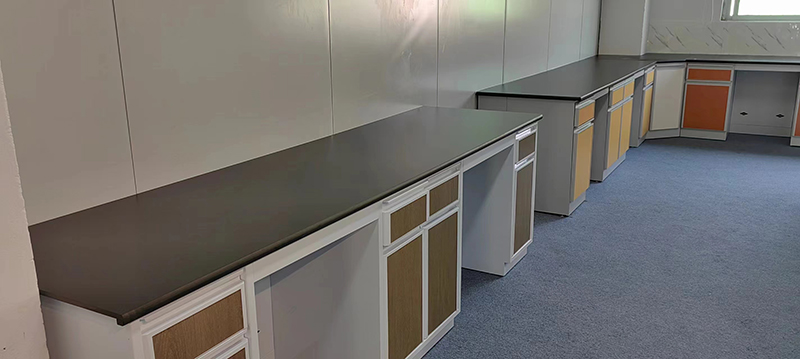 From the perspective of materials and manufacturing processes, customization involves precise control of over 20 parameters such as base materials, thickness, and edge treatment. The initial cost may be 15% to 30% higher than that of standard products, but the payback period is usually completed within three years. For instance, choose a ceramic-coated countertop that can withstand a temperature of 1200 degrees Celsius or a solid physical and chemical board that is resistant to strong acids and alkalis. Its thickness can be increased from 13 millimeters to 25 millimeters to bear a concentrated load of 500 kilograms. A case from a biotech company shows that by customizing a shockproof workbench, they reduced the measurement error of a high-precision balance (with an accuracy of 0.1 milligrams) by 50%. This was attributed to the internal damping structure of the workbench, which reduced the external vibration amplitude by 80%, ensuring the accuracy and repeatability of the experimental data.
Looking ahead, intelligent customization has become a trend. By embedding sensors and Internet of Things (iot) technology, the workbench can monitor temperature, humidity and chemical leakage in real time, and the frequency of data upload to the cloud platform can reach once per second. Research shows that this intelligent laboratory wall-mounted workbench can optimize energy consumption by 10% and extend the equipment's lifespan by 20% through predictive maintenance. Therefore, investing in a deeply customized laboratory wall bench is not only about size matching, but also about building a safe, efficient and future-oriented scientific research ecosystem, whose long-term benefits far exceed the initial budget increment.
From the perspective of materials and manufacturing processes, customization involves precise control of over 20 parameters such as base materials, thickness, and edge treatment. The initial cost may be 15% to 30% higher than that of standard products, but the payback period is usually completed within three years. For instance, choose a ceramic-coated countertop that can withstand a temperature of 1200 degrees Celsius or a solid physical and chemical board that is resistant to strong acids and alkalis. Its thickness can be increased from 13 millimeters to 25 millimeters to bear a concentrated load of 500 kilograms. A case from a biotech company shows that by customizing a shockproof workbench, they reduced the measurement error of a high-precision balance (with an accuracy of 0.1 milligrams) by 50%. This was attributed to the internal damping structure of the workbench, which reduced the external vibration amplitude by 80%, ensuring the accuracy and repeatability of the experimental data.
Looking ahead, intelligent customization has become a trend. By embedding sensors and Internet of Things (iot) technology, the workbench can monitor temperature, humidity and chemical leakage in real time, and the frequency of data upload to the cloud platform can reach once per second. Research shows that this intelligent laboratory wall-mounted workbench can optimize energy consumption by 10% and extend the equipment's lifespan by 20% through predictive maintenance. Therefore, investing in a deeply customized laboratory wall bench is not only about size matching, but also about building a safe, efficient and future-oriented scientific research ecosystem, whose long-term benefits far exceed the initial budget increment.
From the perspective of materials and manufacturing processes, customization involves precise control of over 20 parameters such as base materials, thickness, and edge treatment. The initial cost may be 15% to 30% higher than that of standard products, but the payback period is usually completed within three years. For instance, choose a ceramic-coated countertop that can withstand a temperature of 1200 degrees Celsius or a solid physical and chemical board that is resistant to strong acids and alkalis. Its thickness can be increased from 13 millimeters to 25 millimeters to bear a concentrated load of 500 kilograms. A case from a biotech company shows that by customizing a shockproof workbench, they reduced the measurement error of a high-precision balance (with an accuracy of 0.1 milligrams) by 50%. This was attributed to the internal damping structure of the workbench, which reduced the external vibration amplitude by 80%, ensuring the accuracy and repeatability of the experimental data.
Looking ahead, intelligent customization has become a trend. By embedding sensors and Internet of Things (iot) technology, the workbench can monitor temperature, humidity and chemical leakage in real time, and the frequency of data upload to the cloud platform can reach once per second. Research shows that this intelligent laboratory wall-mounted workbench can optimize energy consumption by 10% and extend the equipment's lifespan by 20% through predictive maintenance. Therefore, investing in a deeply customized laboratory wall bench is not only about size matching, but also about building a safe, efficient and future-oriented scientific research ecosystem, whose long-term benefits far exceed the initial budget increment.