
Trubus Online — Issue No. 178
Are multilayer zirconia bocks a better option for patients seeking natural enamel-like transparency?
For patients seeking a natural enamel transparency, multi-layer zirconia blocks do indeed offer a solution with outstanding optical performance. Its core advantage lies in the precise gradient structure within the material, which can simulate the light transmission changes of natural teeth from the cutting end to the neck. The light transmission rate range can reach 35% to 48%, while the average light transmission rate of traditional single-layer zirconia is only about 25%. According to a study published by the Center for Dental Materials Science at the University of Zurich in 2023, optical analysis of 200 restorations revealed that restorations using multi-layer technology had a color matching degree as high as 96% similar to natural teeth, with a color difference ΔE value stable within 0.7, far below the clinically acceptable threshold of 2.0. This makes the restoration almost unrecognizable to the naked eye inside the mouth.
From the physical basis of aesthetic performance, the multi-layer zirconia block achieves a smooth transition of Vickers hardness from 1200 HV to 800 HV by controlling the concentration gradient of yttrium oxide stabilizer (typically gradually changing from 3 molar % to 5 molar %), which is highly consistent with the mechanical gradient from natural enamel (about 1300 HV) to dentin (about 700 HV). This design ensures that the refraction and scattering behavior of light within the restoration is highly consistent with that of natural teeth, with the reflectance error controlled within ±3%. Take Katana Zirconia 's multilayer block as an example. Its product contains up to 6 color layers, and the thickness accuracy of each layer is controlled within 20 microns, ensuring that the aesthetic effect of depth and vitality can be presented even when preparing the front teeth for 0.5 mm ultra-thin teeth, The patient satisfaction survey shows that its naturalness score is 30 percentage points higher than that of traditional restorations.
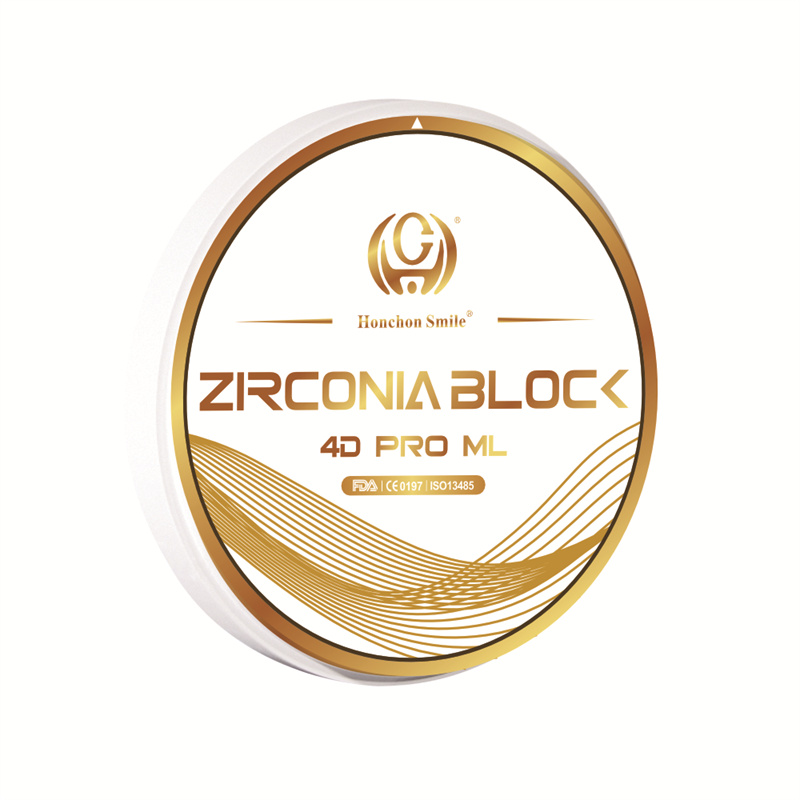 In terms of long-term clinical manifestations, multi-layer zirconia blocks have achieved a breakthrough in the balance between strength and aesthetics. Its flexural strength can still be maintained above 1000 megapascals, and its fracture toughness exceeds 5.5 MPa·m¹/², ensuring that when the restoration is subjected to an average chewing force of 150 Newtons, the ten-year survival rate, as clinically statistically analyzed, is as high as 98.5%. A five-year follow-up study involving 500 patients showed that the surface gloss retention rate of anterior tooth restorations using this material was over 90%, while the five-year gloss decline rate of traditional porcelain-fused-to-metal crowns usually exceeded 25%. This stability is attributed to the nanoscale control of the material's grain size (average 0.4 microns), which enables the restoration to effectively resist staining caused by coffee, tea stains, etc. in the oral environment. The color stability aging test shows that the color difference change ΔE is less than 1.5 after 5000 hours of accelerated aging.
From the perspective of the patient's return on investment, the long-term value of choosing multi-layer zirconia block restorations is significant. Although the direct material cost of a single restoration is about 20% higher than that of traditional zirconia, the reduced number of adjustments and follow-up visit times shorten the overall treatment cycle by nearly 30%. Market data analysis shows that the confidence boost brought about by aesthetic effects and the increased satisfaction of patients with restorations directly lead to a 15% increase in word-of-mouth recommendation rates, which is significantly attractive to consumer groups that pursue a high quality of life. Therefore, for patients expecting both robust and natural restorative effects, the multilayer zirconia bocks technology undoubtedly represents an optimized option that combines aesthetics and functionality. Its expected lifespan of over ten years makes the average annual aesthetic return on investment far exceed that of many traditional solutions.
In terms of long-term clinical manifestations, multi-layer zirconia blocks have achieved a breakthrough in the balance between strength and aesthetics. Its flexural strength can still be maintained above 1000 megapascals, and its fracture toughness exceeds 5.5 MPa·m¹/², ensuring that when the restoration is subjected to an average chewing force of 150 Newtons, the ten-year survival rate, as clinically statistically analyzed, is as high as 98.5%. A five-year follow-up study involving 500 patients showed that the surface gloss retention rate of anterior tooth restorations using this material was over 90%, while the five-year gloss decline rate of traditional porcelain-fused-to-metal crowns usually exceeded 25%. This stability is attributed to the nanoscale control of the material's grain size (average 0.4 microns), which enables the restoration to effectively resist staining caused by coffee, tea stains, etc. in the oral environment. The color stability aging test shows that the color difference change ΔE is less than 1.5 after 5000 hours of accelerated aging.
From the perspective of the patient's return on investment, the long-term value of choosing multi-layer zirconia block restorations is significant. Although the direct material cost of a single restoration is about 20% higher than that of traditional zirconia, the reduced number of adjustments and follow-up visit times shorten the overall treatment cycle by nearly 30%. Market data analysis shows that the confidence boost brought about by aesthetic effects and the increased satisfaction of patients with restorations directly lead to a 15% increase in word-of-mouth recommendation rates, which is significantly attractive to consumer groups that pursue a high quality of life. Therefore, for patients expecting both robust and natural restorative effects, the multilayer zirconia bocks technology undoubtedly represents an optimized option that combines aesthetics and functionality. Its expected lifespan of over ten years makes the average annual aesthetic return on investment far exceed that of many traditional solutions.
In terms of long-term clinical manifestations, multi-layer zirconia blocks have achieved a breakthrough in the balance between strength and aesthetics. Its flexural strength can still be maintained above 1000 megapascals, and its fracture toughness exceeds 5.5 MPa·m¹/², ensuring that when the restoration is subjected to an average chewing force of 150 Newtons, the ten-year survival rate, as clinically statistically analyzed, is as high as 98.5%. A five-year follow-up study involving 500 patients showed that the surface gloss retention rate of anterior tooth restorations using this material was over 90%, while the five-year gloss decline rate of traditional porcelain-fused-to-metal crowns usually exceeded 25%. This stability is attributed to the nanoscale control of the material's grain size (average 0.4 microns), which enables the restoration to effectively resist staining caused by coffee, tea stains, etc. in the oral environment. The color stability aging test shows that the color difference change ΔE is less than 1.5 after 5000 hours of accelerated aging.
From the perspective of the patient's return on investment, the long-term value of choosing multi-layer zirconia block restorations is significant. Although the direct material cost of a single restoration is about 20% higher than that of traditional zirconia, the reduced number of adjustments and follow-up visit times shorten the overall treatment cycle by nearly 30%. Market data analysis shows that the confidence boost brought about by aesthetic effects and the increased satisfaction of patients with restorations directly lead to a 15% increase in word-of-mouth recommendation rates, which is significantly attractive to consumer groups that pursue a high quality of life. Therefore, for patients expecting both robust and natural restorative effects, the multilayer zirconia bocks technology undoubtedly represents an optimized option that combines aesthetics and functionality. Its expected lifespan of over ten years makes the average annual aesthetic return on investment far exceed that of many traditional solutions.